The Ministry of Health marked today (Monday) the inauguration of the Central Public Health Laboratory, a milestone institution envisioned as a hub for innovation and advanced research.
The laboratory, located at Wilayat of As Seeb, is a national, regional, and global reference in public health laboratories, geared towards enhancing health and disease prevention through leadership in laboratory sciences, supporting public and environmental health activities, networking, and rapid response.
The state-of-the-art facility was designed in accordance with the highest laboratory standards and equipped with the latest global technologies and advanced laboratories for tuberculosis testing, bacterial diseases, and high-risk viral diseases. New departments have been introduced for parasitology, mycology, newborn screening for metabolic diseases, and environmental testing for viral diseases and antimicrobial resistance. It further supports sustainable health development by strengthening the capacities of healthcare professionals through an inspiring environment for education and training.
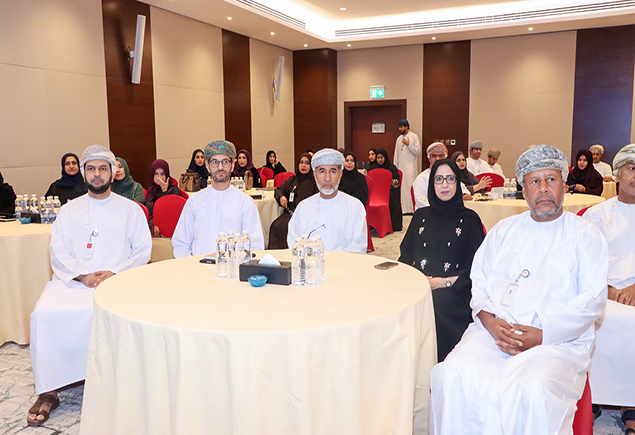
The inauguration ceremony was held under the patronage of His Excellency Sayyid Hamoud bin Faisal Al Busaidi, Minister of Interior, in the presence of His Excellency Dr. Hilal bin Ali Al Sabti, Minister of Health, along with senior officials and dignitaries.
Dr. Ali Al Lawati, MOH’s Advisor to the Minister’s Office for Engineering Affairs, stated that the laboratory represents one of the most significant strategic projects in Oman’s health sector. Built on a land area of (53,000) square meters with a total built-up area of (19,480) square meters, the project cost approximately OMR 18.2 million and incorporates the latest laboratory technologies and advanced facilities.
The three-story building includes high-containment laboratories with biosafety levels (BSL-2 and BSL-3), as well as specialized laboratories in virology, bacteriology, chemistry, toxicology, newborn screening, genomic sequencing, and bioinformatics. It also houses a lecture hall, a library, meeting rooms, and multiple training laboratories to support continuous education and professional development.
Dr. Al Lawati stated that the cost of medical, laboratory, and advanced electronic equipment amounts to nearly OMR 11 million, noting that the Central Public Health Laboratory brings together Ministry’s all existing public health referral laboratories under one roof, significantly enhancing diagnostic capacities through advanced testing, including molecular, microbiological, serological, and chemical analyses.
Dr. Zakaria Al Balushi, Center for Disease Control and Prevention’s Director General, said that the laboratory strengthens the national health system by ensuring high levels of quality, accuracy, and reliability. He emphasized its role in supporting public health objectives and biosecurity through highly efficient laboratory services that contribute to early disease detection and rapid response to public health threats in line with national and international standards.
He added that the laboratory supports national epidemiological surveillance programs through confirmed diagnosis of infectious diseases and coordination with international organizations, as it serves as a World Health Organization–accredited center in specific areas such as polio and influenza. The laboratory also plays a key role in developing and implementing comprehensive quality systems to ensure accreditation and compliance with international standards, in addition to training and qualifying national cadres in public health laboratory sciences and contributing to scientific research and studies.
Dr. Hanan Al Kindiyah, MOH’s Director of Central Public Health Laboratory, described the laboratory as a cornerstone of Oman’s epidemiological surveillance and early warning system, and a national, regional, and global reference for delivering the most accurate laboratory testing. She highlighted its role in supporting disease surveillance programs, outbreak response, workforce development, and advanced laboratory capacity building, thereby strengthening national health security and biosecurity through an integrated system.
She explained that the laboratory undertakes numerous critical functions across its departments, including providing advanced reference services for disease prevention and control, standardizing laboratory practices, promoting environmental health, ensuring food safety through laboratory testing, responding to health emergencies, conducting public health and infectious disease research, implementing quality assurance and accreditation systems, managing laboratory information and data exchange, delivering training and education programs, and fostering partnerships with national, regional, and international institutions.
Among its responsibilities are the development of national quality assurance programs for public and private laboratories, the design and implementation of specialized training programs for medical laboratory professionals, participation in epidemiological research, and the training of university students, medical residents, and health sciences graduates.
In the field of quality assurance, a Quality and Risk Management Section has been established. Laboratories are subject to a comprehensive national quality control program, in addition to participation in regional and international programs such as the British National External Quality Assurance Scheme (UK NEQAS) and the Australian Royal College of Pathologists (RCPA). A number of laboratory specialists have been qualified as assessors and team leaders under ISO 15189 standards, reinforcing efforts to achieve international accreditation. The laboratory continues to play a vital role in training technical staff across the regions on quality implementation and best laboratory practices.
The virology department at the laboratory is the only nationally accredited entity authorized to handle high-risk viral samples that require advanced biosafety containment. The department conducts PCR testing for a wide range of infectious viruses and plays an active role in national committees concerned with the control of infectious diseases.
Meanwhile, the bacteriology department serves as a national reference for the diagnosis of pulmonary and extrapulmonary tuberculosis, antimicrobial resistance testing, malaria diagnostics, and food- and waterborne diseases. It also covers mycology and parasitology testing, examinations for expatriate workers, and oversees the implementation of quality control systems for microscopic malaria diagnosis.
Concluding her remarks, Dr. Al Kindiyah stated that the genomic sequencing laboratory is one of the most distinctive reference laboratories in Oman, uniquely equipped with advanced DNA identification and next-generation sequencing (NGS) technologies. These capabilities enable the analysis of microbial evolution and monitoring of treatment resistance, while supporting national programs for managing serious diseases such as HIV/AIDS, seasonal influenza, poliomyelitis, measles, and rubella, in addition to the diagnosis of tuberculosis and mycobacterial infections.
An internal committee within the Laboratory is responsible for biosafety and biosecurity, supervising quality and biosafety requirements, developing policies and standards governing safety in medical laboratory environments, and monitoring compliance to ensure the protection of staff and the surrounding environment.
The Quality Assurance Laboratory manages national and regional programs to monitor the accuracy and reliability of results from public and private laboratories. It prepares and distributes quality control materials, identifies performance gaps, and participates in regional quality programs under the supervision of the World Health Organization (WHO).
Highlighting the laboratory’s regional significance, Dr. Amina Al Jardaniyah, Senior Consultant at the Central Public Health Laboratory, said the laboratory is regarded as one of the leading reference centers in the Eastern Mediterranean Region. It undertakes WHO-accredited regional functions, including reference laboratories for influenza, poliomyelitis, measles, rubella, and emerging and re-emerging diseases, in addition to its role within the PulseNet Middle East network.
With its advanced capabilities in molecular diagnostics and genomic surveillance, the laboratory supports member states in strengthening outbreak preparedness and response, enhancing laboratory capacity, and delivering specialized training, she added. These roles contribute significantly to strengthening health security and improving the efficiency and quality of laboratory surveillance networks across the region.