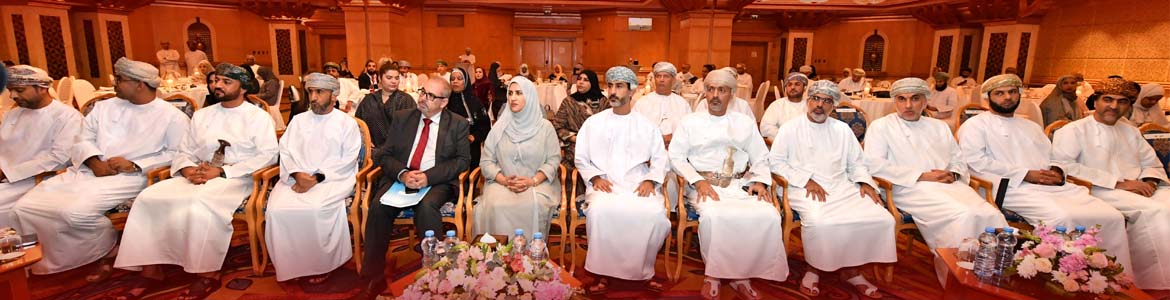
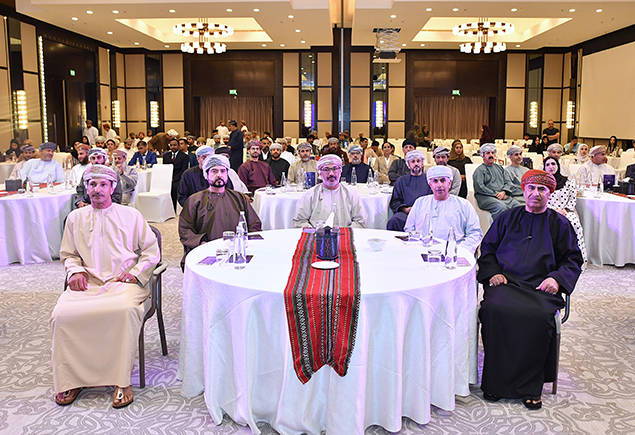
The Ministry of Health represented by the Centre of Studies and Research at the Directorate General Planning & Studies, and in collaboration with the World Health Organization Office in the Sultanate of Oman organized on Tuesday Health Research Funding forum at the Grand Hyatt Muscat.
The event was held under the auspices of HE Dr. Fatima Mohammed Al Ajmi, MOH’s Undersecretary for Administrative, Financial, and Planning Affairs, with the presence of number of their Excellencies from government authorities and executive directors of private companies and from other research mobility supportive institutions.
The opening program included a welcome note delivered by Dr. Qasim Al Salmi, Director General of Planning & Studies stating that the scientific research and innovation, which is the cornerstone of a nation’s progress, is an enabler that allows decision makers to develop their knowledge and understanding, and provide them robust evidence to make informed decisions in order to be more efficient, transparent, and at the forefront alongside other developed countries of the world.
Al Salmi added that the pillars of research are embedded in each of our institutions, and we can catalyse on this to drive us to excellence to provide successful outcomes. It is thus our hope to engage all of you present here as planners, commissioners and service providers to ensure that the voice influences the whole process.We strive to evolve the processes so that they are more inclusive as a whole, working towards all our goals in order to provide the best health and social care across the lifespan in terms of planning, commissioning and delivery.
The Director General of Planning & Studies confirmed that research can identify critical problems, options to solve these problems, estimate the costs and consequences, investigate the benefits and harms, and is essential to improving health systems performance and contributing to the achievement of universal health coverage. Importantly, it also provides the best available health research evidence in making informed health policy decisions.
Embedded approaches to implementation, whereby decision-makers participate actively in the research process, are gaining traction as effective approaches to optimize the delivery of health programs and policies, Al Salim pointed out. He added that the efforts made would also serve to address health economy for the sustainability of healthcare financing through the optimal utilization of the available resources which will contribute to enhancing the efficiency of the health system and achieving prospective socioeconomic development. It is thus imperative to provide a supporting and nurturing environment for research and innovation to thrive in Oman.
Moreover, HE. Dr. Jean Jabbour, WHO Representative in Oman affirmed in his speech at the opening of the forum that the Organization has long supported research and development of innovative products and interventions to constantly ensure the global community can address unmet health needs.
He pointed out that this is showcased by the WHO’s plethora of advanced programs and tools used to assess and collate information on global health research to enhance, optimize, and prioritize research agenda.
WHO Representative in Oman pointed that in this regard the Center of Research and Studies in MOH has focused on setting National research priorities every 5 years based on the national evaluation of the health system performance and monitoring the prevalence and incidence of diseases and risk factors, adding that risk factors, diseases and health systems research are the three themes for the upcoming three years.
The Sultanate of Oman has developed over the years variable strengths in the medical research field, from a well-developed governance system to an effective health information system, availability of research infrastructure with state-of-the-art facilities, and the establishment of the Oman Medical Journal, Dr. Jabbour highlighted.
The WHO address further emphasized that Center of Research and Studies has proposed the ‘ Health Vision 2050 for Health Research’ with the aim of making Oman the regional leader and research hub based on the WHO’s Framework for Action.
The event shed light of three themes first of which was the revolution space that focused on the impact of funding medical research from NGO and Private Institutions, while the capability theme discussed organ transplantation and chronic kidney disease. The third theme on scientific and technical creativity addressed the role of research on country development (the opportunities and challenges).
The event also reviewed the creative ideas to raise fund opportunities.
The forum proves the Ministry's belief in the importance of scientific research as research and health surveys are considered an essential complement to health information systems to form an integrated database that serves the purposes of planning, implementation, follow-up and evaluation. Health research and surveys are used to prioritize health problems and community needs.
the Ministry is striving to improve the quality of research to keep pace with advancing the knowledge forward, in accordance with the future government vision based on the vision of Oman 2040, that is centered on promoting research and innovation and supporting policies with evidence.
Therefore, the Ministry of Health has established the Center of Studies and Research in 1991, held numerous training workshops on research methodology, and sent some personnel to study abroad, in addition to placing studies and research as one of the themes and components of the health vision 2050 and Oman vision 2040.