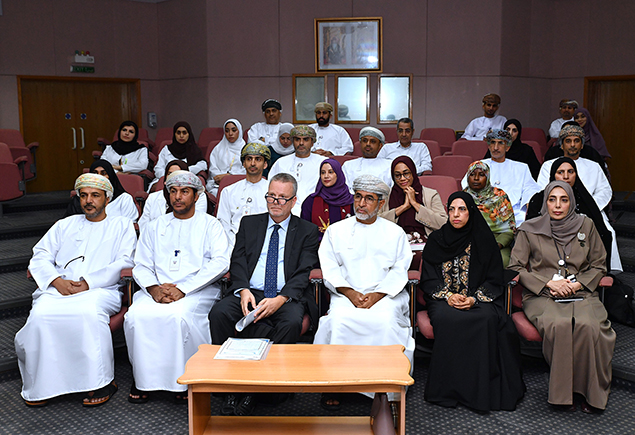
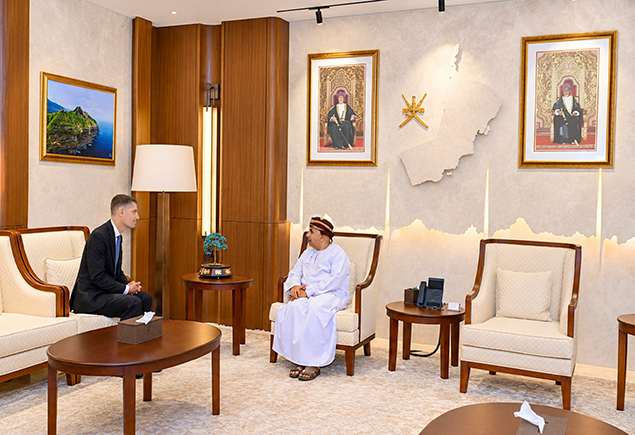
The Ministry of Health (MOH), represented by the Department of Rehabilitation and Palliative Care Services at the Directorate General of Health Services and Programs, in collaboration with the World Health Organization Office in the Sultanate of Oman, launched today (Monday) the second phase of the training program for healthcare professionals in palliative care in the Main Hall of the Royal Hospital.
The ceremony was held under the patronage of H.E. Dr Ahmed bin Salem Al Mandhari, MOH Undersecretary for Health Planning and Regulation, in the presence of H.E. Dr Asmus Hammerich, WHO Representative in the Sultanate of Oman, Dr Badriya bint Mohsen Al Rashidi, Director General of Health Services and Programs, and a number of officials and directors from the Ministry, the Royal Hospital and the WHO Office in the Sultanate of Oman.
The ceremony also featured an address by Dr Badriya Al Rashidi, Director General of Health Services and Programs at the Ministry of Health, who highlighted the importance of palliative care, the current state of palliative care services in the Sultanate of Oman, and future directions for their development.
H.E. Dr Asmus Hammerich, WHO Representative in the Sultanate of Oman, also delivered an address highlighting the importance of partnerships in supporting health initiatives and advancing healthcare services in the Sultanate.
Dr Nahla Jaafar, Palliative Care Expert at the WHO Regional Office, provided an overview of the training program aimed at building the capacity of healthcare professionals in palliative care.
The ceremony included a visual presentation on the expansion of the project and the efforts undertaken to develop it and expand the provision of palliative care services.
The program, implemented in collaboration with the WHO Office in the Sultanate of Oman, targets 48 healthcare professionals, with 12 trainees from each of the four targeted hospitals. It builds on the first phase, which was delivered virtually in September and October of the previous year and focused on the fundamental concepts and principles of palliative care, with the participation of specialized experts from the WHO Regional Office. The second phase involves face-to-face training aimed at developing the practical and applied skills of participating healthcare professionals.
The program is being implemented as part of the project for strengthening and expanding palliative care services, which aims to establish and operationalize four new palliative care units at the Royal Hospital and Sultan Qaboos Hospitals in Salalah, Sohar and Sur. This will help expand the scope of these services and improve access to them across the various governorates of the Sultanate of Oman. The project is part of the Ministry of Health’s efforts to enhance the quality of healthcare services provided to patients with serious, chronic and advanced illnesses, while also supporting their families.
The second phase of the training program aims to strengthen healthcare professionals’ practical skills in pain assessment and management, as well as in managing symptoms associated with chronic and advanced illnesses. It also seeks to enhance effective communication skills with patients and their families and promote the delivery of comprehensive care that addresses patients’ physical, psychological, and social needs, thereby improving the quality of care provided to beneficiaries.
Palliative care is a fundamental component of modern healthcare systems. It aims to improve the quality of life of patients and their families by preventing and alleviating suffering, relieving pain and managing symptoms associated with serious illnesses, while preserving patients’ dignity and providing the necessary support to them and their families. Palliative care is provided alongside other medical treatments and in accordance with each patient’s healthcare needs.
The expansion of these services comes in response to the demographic and epidemiological changes taking place in the Sultanate of Oman, alongside the growing burden of non- communicable diseases (NCDs), which account for approximately 83% of total deaths. This further underscores the importance of developing palliative care services and integrating them across all levels of healthcare delivery.
The program is expected to contribute to developing a qualified national workforce in palliative care and ensuring the sustainability of its capabilities, while strengthening the readiness of the targeted healthcare institutions to provide these services. This will support the Ministry of Health’s vision of delivering integrated, patient- and family-centered healthcare and improving the quality of life of those most in need of palliative care services.