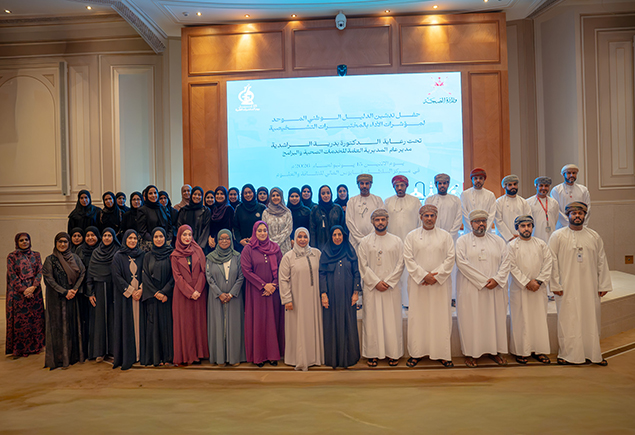
The Ministry of Health (MOH), represented by the Department of Health Services Development at the Directorate General of Health Services and Programs at the Sultan Qaboos Higher Center for Culture and Sciences, launched today (Monday) the “Unified National Guide for Performance Indicators in Diagnostic Laboratories,” along with its accompanying training program.
The program is designed for technical staff working in medical laboratories, to enhance their capabilities in applying the guide and its operational procedures in the field.
The launch ceremony was held under the patronage of Dr. Badriya Mohsin Al Rashdi, Director General of Health Services and Programs, who emphasized in her remarks the importance of the Ministry’s continued efforts to establish standardized operational frameworks across the health sector. She also highlighted the ongoing development of the diagnostic laboratory system in line with the objectives of Oman Vision 2040, and in a way that enhances the quality of healthcare services provided to both citizens and residents.
The Unified National Guide aims to provide a comprehensive standardized regulatory framework that includes a set of technical and administrative standards and indicators designed to improve the quality of medical testing and enhance operational efficiency within diagnostic laboratories.
The guide addresses several key performance indicators, most notably the sample rejection rate, which serves as a measure of the quality of sample collection, transportation, and storage processes. It also includes the laboratory test turnaround time indicator, which ensures the timely issuance of medical reports and supports prompt clinical decision-making.
The guide also includes indicators for monitoring diagnostic error rates, assessing the efficiency of laboratory equipment and technologies utilization, as well as strengthening the implementation of total quality management systems and continuous improvement tools. These measures contribute to enhancing safety standards and improving overall quality within medical laboratories.
Approximately 70 healthcare leaders and decision-makers in the Sultanate of Oman have attended the launch ceremony including the Director General of the Quality Assurance Centre, the Director General of Information Technology and Digital Health, as well as the Directors General of the Directorates of Health Services across various governorates.
The event was also attended by a number of quality officers and laboratory technical staff from the Ministry of Health, along with representatives and specialists from Sultan Qaboos University Hospital and the Medical City for Military and Security Services. Their participation underscored the spirit of partnership and integration among various civilian and military healthcare institutions.
The launch of the guide is accompanied by a training program that includes specialized workshops extending over three days. These workshops focus on enabling medical and laboratory staff to understand the approved national indicators, their calculation methodologies, and their practical application, with direct integration to the Shifa electronic system. This integration is intended to ensure the automation of performance measurement processes, improve the accuracy of periodic reporting, and facilitate the timely monitoring of diagnostic deviations. The intensive workshops aim to enhance the efficiency of laboratory services and standardize monitoring and evaluation criteria across the healthcare system.
The first training session was launched today at the Sultan Qaboos Higher Center for Culture and Sciences, organized under the supervision of Zainab Mohammed Al Hadhrami, Senior Laboratory Specialist (A). The session was attended by 25 quality officers from hospital laboratories and aimed to introduce the guide and highlight its strategic importance, along with presenting the application methodology of performance indicators for the Clinical Chemistry Department.
The second and third-day sessions will be held at the lecture hall of the Royal Hospital, featuring intensive theoretical and practical training.
The sessions also emphasize hands-on practical training, equipping quality officers with the skills to calculate performance indicators and electronically monitor them. They further focus on leveraging strengths by enabling staff to identify and capitalize on areas of strength, thereby overcoming operational challenges and achieving strategic objectives.
This approach aims to deliver high-quality diagnostic services within benchmark timeframes, while optimizing resource utilization and minimizing waste. This is intended to deliver high-quality diagnostic services within optimal timeframes, while promoting efficient resource utilization and reducing waste.