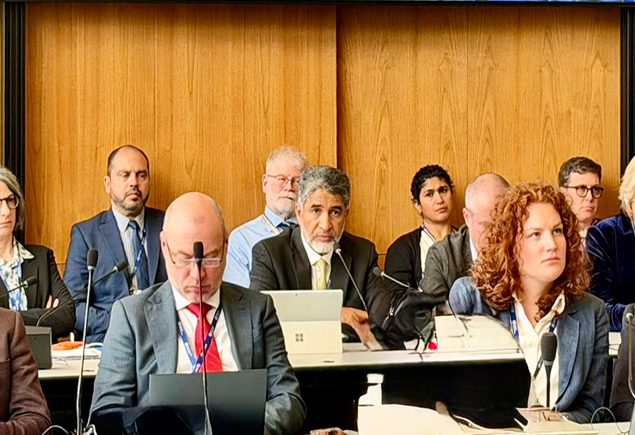
Underscoring the Sultanate of Oman’s growing international role in digital health transformation, the Sultanate of Oman and the Swiss Confederation jointly organized a high-level international event titled “Trusted Data in the Age of Artificial Intelligence (AI) for Effective Health Policymaking.” The event was held at the headquarters of the World Health Organization (WHO) on the sidelines of the Seventy-ninth World Health Assembly (WHA79), with broad participation from policymakers, experts, representatives of international organizations, and member states.
The event featured the participation of H.E. Dr. Ahmed bin Salim Al Mandhari, Undersecretary of the Ministry of Health (MOH) for Health Planning and Regulation, who represented the Sultanate of Oman in this strategic international dialogue aimed at strengthening the reliability of health data and leveraging artificial intelligence to support evidence-based health policymaking.
The event was jointly organized by the Sultanate of Oman and Switzerland, with the participation of several countries and international organizations, reflecting the growing global interest in advancing health data governance frameworks and promoting the safe and responsible use of artificial intelligence technologies in the healthcare sector.
The event underscored that the quality of health decision-making is closely tied to the quality and reliability of data, and that the future of artificial intelligence in healthcare fundamentally depends on building accurate, secure, and interoperable data systems.
Discussion sessions addressed three main aspects: health data governance, countries’ readiness to adopt artificial intelligence technologies in the healthcare sector, and the role of trusted data in supporting health policymaking, enhancing the efficiency of health systems, and strengthening responses to emergencies and epidemics.
In his remarks during the event, H.E. Dr. Ahmed Al Mandhari highlighted Oman’s experience in digital health transformation, noting that Oman has given strategic priority to building an integrated national health data ecosystem, through the development of the “Al-Shifa” system, which connects more than 85% of healthcare institutions across the various governorates, providing an advanced digital infrastructure that supports artificial intelligence applications and enhances the accuracy and efficiency of healthcare services.
The MOH Undersecretary for Health Planning and Regulation explained that Oman has moved beyond the exploratory phase of artificial intelligence to its practical application across multiple domains, including clinical decision support, early diagnosis, intelligent epidemiological surveillance, and improved healthcare resource management, as well as the analysis of large-scale health data to support decision-makers. These efforts are implemented within clear governance frameworks and standards that ensure privacy, safety, and reliability.
He also highlighted Oman’s experience with virtual clinics, which have contributed to expanding access to specialized healthcare services, particularly in remote areas, and to strengthening continuity of care for patients with chronic conditions and the elderly. This reflects the impact of digital transformation in improving the quality of life and enhancing the healthcare services provided to the community.
Furthermore, he stressed that combating health misinformation has become a global challenge requiring international coordination and collective action, emphasizing that building transparent and reliable data systems represents the first line of defense in protecting societies and strengthening trust in health decisions.
In conclusion, Al Mandhari expressed the Sultanate of Oman’s readiness to actively participate in international initiatives emerging from the event, including the “Trusted Data Observatory” and the upcoming AI Summit in Geneva in 2027. He affirmed that international cooperation remains the most effective pathway to building a more equitable, efficient, and sustainable digital health future.
The event concluded with three key messages: that effective health policies begin with reliable and secure data, that artificial intelligence is only as strong as the quality of the data it relies on, and that combating health misinformation is a shared responsibility requiring effective international partnerships.
This joint international event between the Sultanate of Oman and Switzerland reflects Oman’s growing presence in shaping the future of global digital health, as well as its advanced role in supporting international initiatives aimed at harnessing modern technologies and artificial intelligence to serve human health and enhance quality of life.