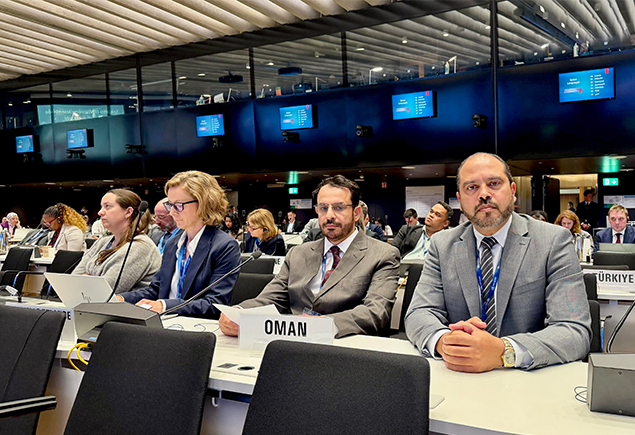
The Sultanate of Oman participated in the proceedings of the Seventy-ninth World Health Assembly (WHA79), held in Geneva from 18 to 23 May, and actively contributed to discussions on key global health agenda items.
In its statement under the agenda items related to strengthening preparedness, readiness, and response to health emergencies, as well as supporting the implementation of the International Health Regulations (2005), Oman emphasized the importance of enhancing global health governance and developing coordination mechanisms across international, regional, and national levels, particularly in light of increasing challenges linked to climate change and cross-border risks.
The Sultanate of Oman is steadily advancing its national preparedness and response system through the strengthening of epidemiological surveillance systems, enhancing the diagnostic capacities of reference laboratories, and updating emergency response plans in line with the One Health approach. This also includes the development of integrated digital platforms for managing emergencies and health reporting.
Under the agenda items related to the World Health Organization’s work in health emergencies and strengthening data systems supporting public health measures, Oman highlighted its national achievement in developing a robust health information system. The continuous annual health report, issued since 1976, stands as a long-standing testament to the reliability of Omani health data and its regional and international recognition.
Oman’s position concluded that current challenges require strengthened international cooperation, investment in national human capital, and the adoption of the One Health approach.
On the sidelines of the meeting, Dr. Rashid bin Mohammed Al Alawi affirmed that health emergency preparedness is an institutional imperative that allows no compromise, noting that the hospital continues to strengthen rapid response plans and build qualified cadres capable of operating under the most challenging conditions.
He stressed that the quality of health data is a cornerstone of sound decision-making, highlighting ongoing efforts to further develop the information system and enhance surveillance and early warning mechanisms in line with national priorities. He also expressed hope for increased international support in the areas of capacity-building, knowledge transfer, and health technology.
In the same context, Dr. Hani bin Ahmed Al Qadhi explained that the International Health Regulations (2005) represent a global solidarity compact that is translated into tangible daily actions, ranging from strengthening preparedness at land, sea, and air points of entry, to enhancing the capacity of reference laboratories and updating emergency response plans in line with the One Health approach.
Al Qadhi indicated that the climate-related challenges facing the region have made coordination between the health, environment, and agriculture sectors a necessity rather than an option. He further called for increased investment in healthcare workforce capacity in remote areas, as well as ensuring equitable access to vaccines, diagnostics, and treatments.