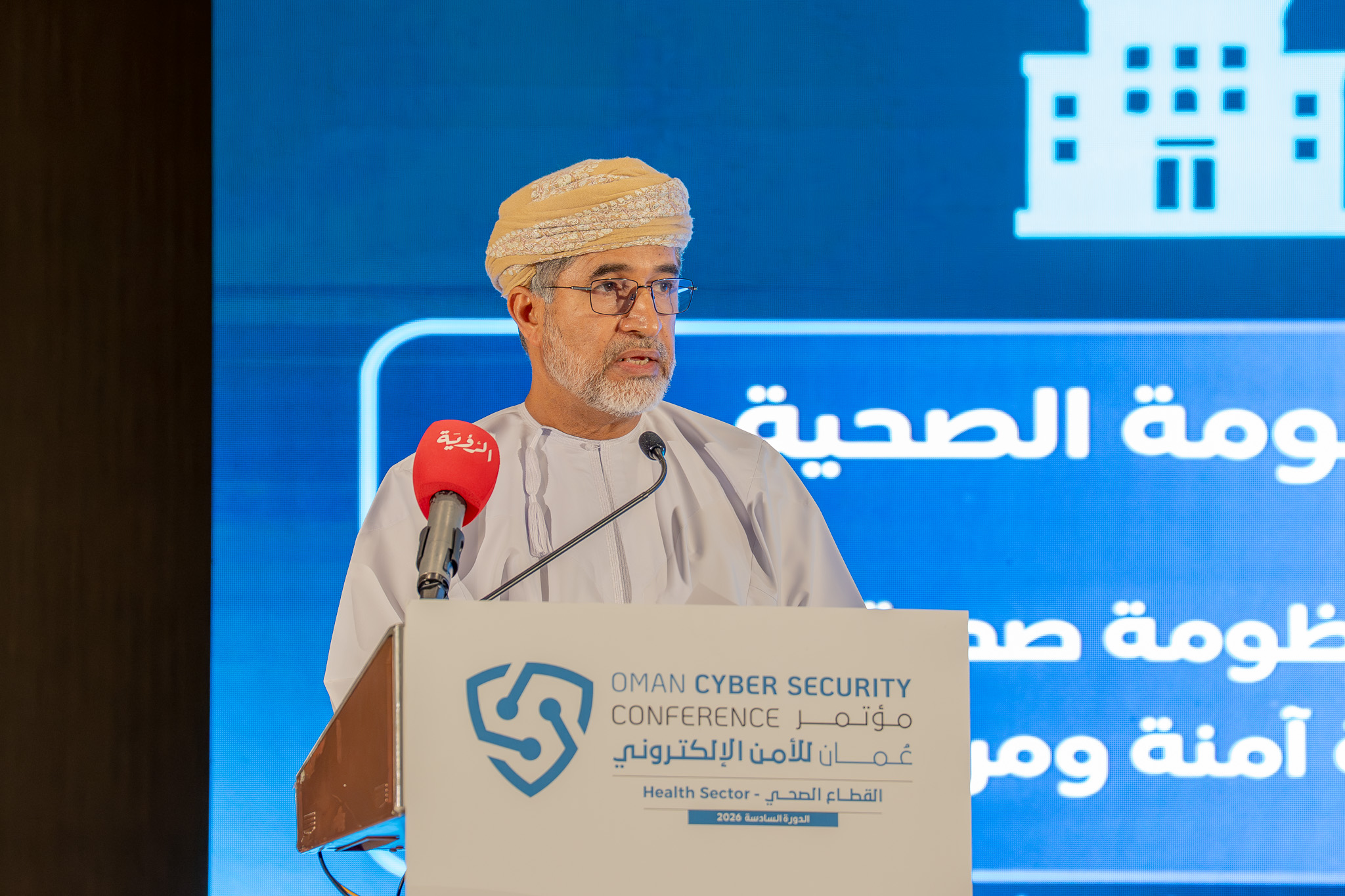
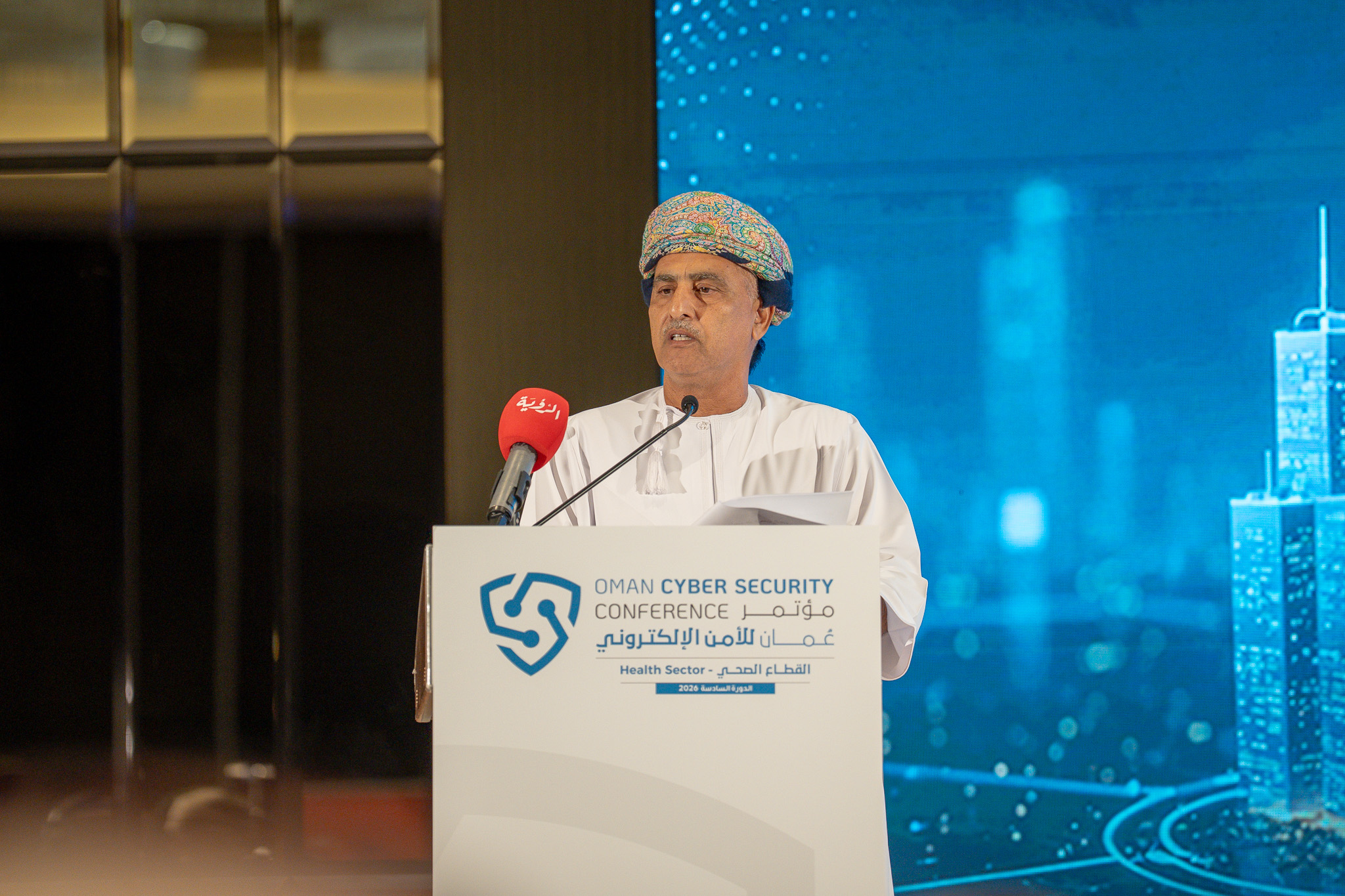
The 6th edition of the Oman Cybersecurity Conference 2026 commenced today (Thursday) at the Millennium Hotel Muscat under the theme “Cybersecurity in the Healthcare Sector,” with the participation of a distinguished group of experts, specialists, and decision-makers from within and outside the Sultanate of Oman.
The conference was inaugurated under the patronage of His Excellency Dr. Hilal bin Ali Al Sabti, Minister of Health, and was attended by a number of Excellencies, dignitaries, and officials from various entities.
The event aims to enhance digital readiness and protect the healthcare sector’s technological infrastructure amid the rapid expansion of digital transformation.
The conference is organized as an initiative by “Al Roya”, in collaboration with the Ministry of Health, represented by the Directorate General of Information Technology and Digital Health and the Cyber Defense Centre, with the participation of national and international institutions specialized in cybersecurity and modern health technologies.
The conference proceedings began with a welcome address delivered by Honourable Hatem bin Hamad Al Taie, Secretary General of the Conference, followed by an opening statement presented by Eng. Khamis bin Salim Al Hajri, Head of the Cyber Defense Centre, in which he highlighted the importance of strengthening cybersecurity in the healthcare sector as one of the vital sectors linked to national security and the continuity of essential services.
Furthermore, the opening ceremony also featured a video presentation showcasing the outcomes of the National Cybersecurity Exercise in the healthcare sector, highlighting the readiness of national competencies and response mechanisms to potential cyber threats, as well as underscoring the level of coordination among relevant entities in managing cyber risks.
His Excellency Dr. Ahmed bin Salim Al Mandhari, Undersecretary of the Ministry of Health for Health Planning and Regulation, affirmed in his opening speech that cybersecurity has become a fundamental pillar for sustaining digital transformation in the healthcare sector. He indicated that protecting health systems and data is no longer a purely technical responsibility, but a national responsibility that requires the integration of roles across various institutions.
Al Mandhari explained that the expansion in the use of electronic health records and smart platforms has brought about a qualitative transformation in healthcare delivery methods, making cybersecurity a cornerstone for ensuring system reliability, safeguarding data privacy, and enhancing users’ trust in digital health services.
Undersecretary of the Ministry of Health for Health Planning and Regulation added that this approach is aligned with the objectives of Oman Vision 2040, which has placed digital transformation and cybersecurity at a central priority level, considering them key enablers for achieving sustainable development and enhancing the efficiency of government services.
He pointed out that the Ministry of Health is adopting a proactive approach to move from the stage of cyber risk awareness to actual readiness, through the implementation of national exercises and simulations of realistic scenarios aimed at testing system efficiency and enhancing institutional preparedness to respond to cyber incidents.
He further explained that the Ministry is continuing to upgrade its technological infrastructure, develop regulatory policies, and invest in specialized national competencies, in addition to leveraging artificial intelligence technologies in risk analysis, threat anticipation, and enhancing the speed of response to digital challenges.
Dr. Al Mandhari also commended the existing integration with the “Hadatha” cybersecurity industry programme, implemented by the Ministry of Transport, Communications and Information Technology, which aims to develop national capabilities and build a specialized cybersecurity industry that fosters innovation and enhances the competitiveness of Omani talent.
For his part, Eng. Khamis bin Salim Al Hajri, Head of the Cyber Defense Centre, affirmed that cybersecurity in the healthcare sector is no longer a technical option, but has become a national necessity to protect lives and ensure the continuity of vital healthcare services, in light of the rapid digital transformation taking place in the sector.
Al Hajri pointed out that healthcare institutions worldwide are facing increasing challenges due to the rising number of cyberattacks, noting that the cost of a single healthcare data breach may exceed ten million US dollars. He also indicated that more than 70% of healthcare institutions globally have experienced cyber incidents within a single year, adding that phishing attacks represent the primary entry point for the majority of these breaches.
The Head of the Cyber Defense Centre explained that around 50% of cyber incidents in the Middle East during 2025 were linked to ransomware attacks and financial extortion, underscoring the need to strengthen institutional readiness and enhance compliance with national cybersecurity standards and policies.
Eng. Khamis bin Salim Al Hajri outlined six key pillars for strengthening the protection of the healthcare sector, which included compliance with national policies and controls, the implementation of the Personal Data Protection Law, and adherence to the security policies of the “Dhamani” platform, in addition to intensifying training and awareness programmes and enhancing the protection of digital systems in line with international best practices.
He noted that the Sultanate of Oman has issued more than 45,000 trusted digital health certificates for pilgrims over the past three years, at an annual average of around 15,000 certificates. This has enabled pilgrims to securely carry their health data in a verifiable format that can be instantly authenticated across different countries worldwide.
He explained that the adopted system is based on an advanced technological infrastructure developed by the World Health Organization, which ensures the privacy of health data and its verifiability without the need for centralized databases that are vulnerable to breaches or failures. He further noted that more than 82 countries worldwide are now able to utilize this shared technological framework.
Al Hajri affirmed that the new amendments to the International Health Regulations will require countries, starting from the fourth quarter of 2026, to support digital international certificate systems for vaccination and health status certificates. He indicated that the Sultanate of Oman has outpaced many countries in the readiness and effectiveness of this system.
The conference witnessed international participation, including the attendance of Dr. Alain Labrique, Director of Digital Health and Innovation at the World Health Organization, who affirmed that the Sultanate of Oman represents an advanced global model in leveraging digital technologies to protect health data and enhance the efficiency of healthcare services.
The conference sessions discussed three main aspects addressing the challenges of personal and health data security, cloud computing security and digital infrastructure, as well as the application of artificial intelligence technologies in strengthening cybersecurity within the healthcare sector, with the participation of specialists from government entities, the private sector, and academic institutions.
The conference also witnessed the launch of the “Cyber Compliance Award in the Healthcare Sector,” aimed at encouraging healthcare institutions to implement the best practices and security standards, and to enhance levels of compliance and digital readiness.